Livestream key takeaways: The state of German BESS revenues
Livestream key takeaways: The state of German BESS revenues
Germany's battery market is entering a new phase.
 Free guide from Modo EnergyPutting AI to work in energy investment and asset managementTurning Germany market analysis into a repeatable process? A practical playbook for using AI tools across your energy investment and operations teams, featuring tangible, timesaving tips and tricks you can put to use immediately.Download the guide →
The revenue stack is shifting: Ancillary services are compressing onto day-ahead, while a new wave of policy-driven interventions is adding revenue uplift.
In our livestream "The State of German BESS Revenues," Till Stehr and Cosima Sagmeister walk through how batteries are earning today and where revenues are heading, using Modo Energy’s German BESS revenue forecast and benchmark.
Germany needs flexibility: the structural case for BESS
On May 1, 2026, day-ahead prices crashed to -€499.99/MWh at midday under heavy solar feed-in and spiked in the evening, with a lack of flexible generation to bridge the gap.
Modo Energy’s 2H BESS benchmark battery captured the highest single-day return of 2026 that day, paid to absorb negative-priced power at midday and paid again to discharge in the evening. Day-ahead arbitrage drove the day's return.
Holiday weekday curves like this one already highlight a normal situation in the future unless flexibility is built out substantially. The 2030 forecast shape differs only because batteries lift around 10 GW of charging at midday to bridge the solar surplus into evening peaks.
Saturation: ancillary returns are converging to day-ahead
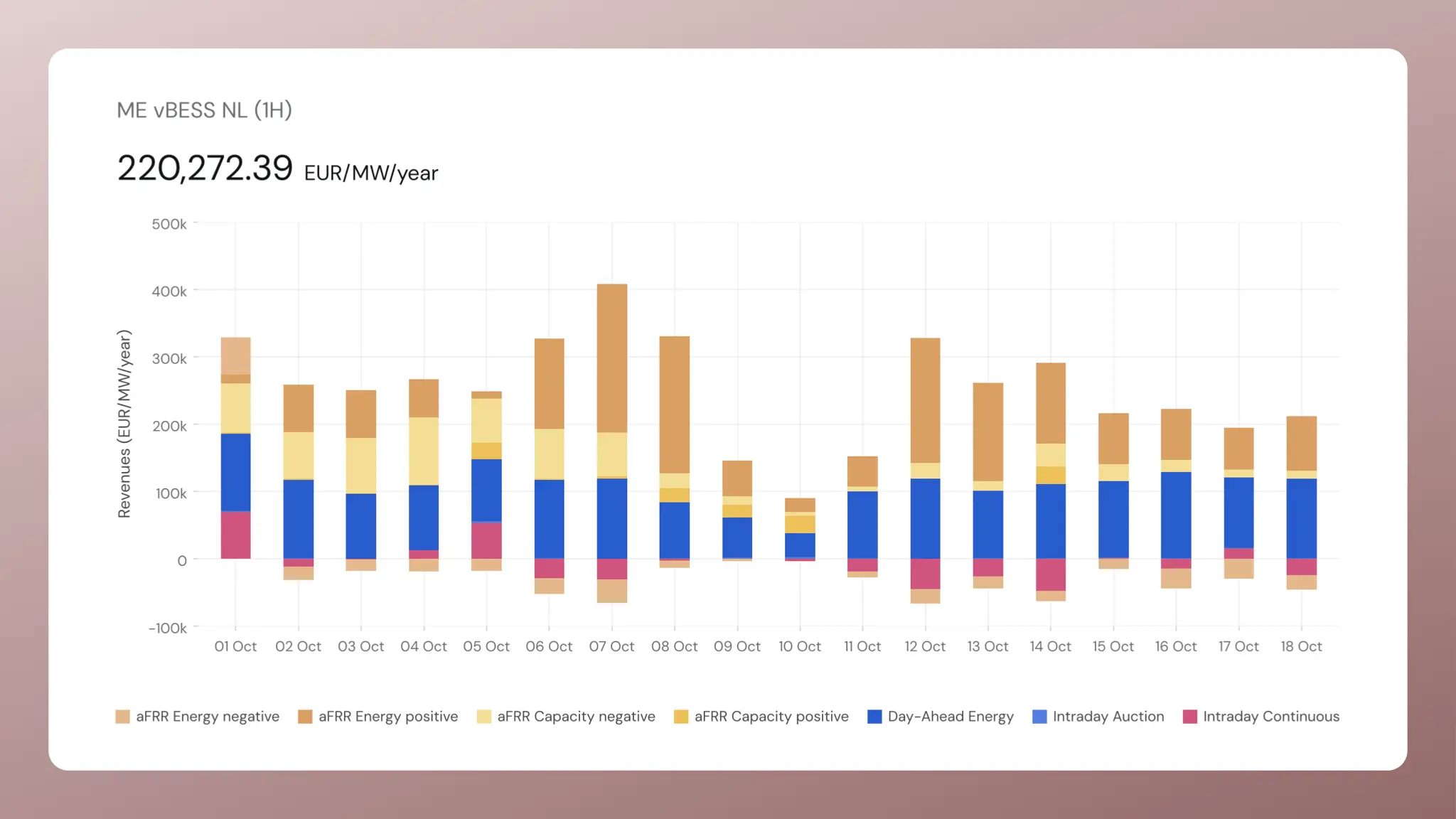
The German benchmark has been narrowing in on the TB2 spread over the last six months. The ancillary premium that defined 2024 and early 2025 has started to compress.
The mechanism is familiar from Great Britain. Once prequalified battery capacity overtakes the ancillary market size, bidding starts to converge to battery opportunity cost rather than the cost of gas. GB found its floor in 2023.
March's rebound in German ancillary clearings came from higher gas lifting the floor for thermal reserves. But day-ahead opportunities also got better, and ancillary-boosted and day-ahead shapes now track closely.
Even in a 78 GW BESS overbuild scenario, average TB spreads compress by 40% rather than collapsing. Day-ahead holds value even at significant battery penetration, showing that this is a deeper market for batteries.
Gas prices: the single largest revenue sensitivity
A 50% increase in gas prices lifts 2030 day-ahead revenues by roughly 30% in Modo Energy's central case. Of every sensitivity tested, gas moved the dial furthest.
TTF prices currently sit around 50% above pre-war levels after the Middle East conflict pushed them higher in early 2026. That elevated level supports today's German BESS returns.
Modo Energy’s fundamentals modelling shows gas running more flexibly through 2030, with steeper ramping into evening peaks. Germany is also tendering new gas plants.
Grid fees and FCAs: increased clarity is improving bankability
The regulator confirmed capacity-based grid fees of €4-7k/MW/yr last week. The TSOs' earlier proposal of €53k/MW/yr is off the table.
For an unconstrained battery, that is around 4% of annual revenue. Even under a flexible connection agreement, the worst case eats roughly 6%. Energy-based grid fees, which would have forced operators to skip profitable cycles, did not survive consultation.
Assets apply for a grandfathering exemption for these grid fees under two conditions: Firstly, they have to connect before 4 August 2029. Secondly, FID on the project has to be taken before the final document is published, expected end of 2026, with FID defined as a 50% binding orders threshold against the total investment.
FCA templates are also becoming easier to model. The SH-Netz framework restricts import in low-renewable periods and export in high-renewable periods. Modo Energy's Apr-2026 modelling shows 1 to 2% revenue impact for import/export caps alone, rising to roughly 7% once ramp rates and ancillary caps are layered on.
New revenue streams: dynamic fees, inertia, and capacity market
From 2030-2033 at the latest, TSOs will publish day-ahead grid fees for 22 regions at 15-minute granularity. Fees can be negative, rewarding charging during local oversupply, or positive, rewarding discharge during local deficits.
Modo Energy's modelling finds the regime is net positive in every region tested. The Bundesnetzagentur agrees, which is why the scheme will apply to existing assets as well as new build. This is zonal pricing through the back door.
Inertia is the more immediate upside. Grid-forming inverters with overload capability can earn around €10,000 per MW per year selling inertia alone based on availability payments.
Inertia contracts run two to ten years at expert-set prices, improving bankability compared with merchant ancillary revenue. Overload-capable inverters go above rated power for the few seconds that inertia response is needed, leaving core megawatts free for energy and ancillary markets.
A German capacity market is in design, with rollout still ahead. Combined with dynamic grid fees and inertia, the new streams will offset some of the saturation visible today.
Access the livestream slides below.