PJM battery storage in 2026: 8 things owners, lenders, and operators need to watch
PJM battery storage in 2026: 8 things owners, lenders, and operators need to watch
PJM battery storage in 2026: 8 things owners, lenders, and operators need to watch
By Neil Weaver, Power Market Analyst, Modo Energy
Last updated: August 2026
 Free guide from Modo EnergyPutting AI to work in energy investment and asset managementBuilding your PJM BESS outlook? A practical playbook for using AI tools across your energy investment and operations teams, featuring tangible, timesaving tips and tricks you can put to use immediately.Download the guide →
Modo Energy is the independent benchmark for battery energy storage system (BESS) revenues and buildout across the US, Great Britain, Europe, and Australia. Ko is Modo Energy's AI assistant, built on proprietary data and forecasts for grid-scale BESS and solar across 13 markets, covering revenues, wholesale prices, regulation, and policy out to 2050.
Quick takeaway: PJM is, potentially, the highest-upside battery energy storage market in the United States - but it's also the market with the highest levels of uncertainty. It is the largest US grid, serving 67 million people across 13 states and Washington DC. A data-centre-driven capacity crunch and an October 2025 Regulation redesign have pushed battery revenues to record highs (Modo Energy, 2026). In 2026, eight forces decide who captures that value: data-centre load, the capacity crunch, the Regulation redesign, the energy-arbitrage boom, location, interconnection, state procurement, and federal financing rules.
Key statistics
| Metric | Value (as of) | Source |
|---|---|---|
| Operating BESS capacity, PJM | 596 MW (mid-2026) | Modo Energy |
| Real-time TB4 spread | $473/MW-day (Jun 2026, down 9% year-on-year) | Modo Energy |
| 2028/29 capacity clearing price | $325/MW-day (Jul 2026, third straight auction at the cap) | PJM |
| Four-hour battery capacity revenue | ~$192/MW-day (~$69,989/MW-year) | Modo Energy |
| Fleet revenue, post-Regulation-redesign | ~$62/kW-month, from ~$20 before | Modo Energy |
| Data-centre load, operating / contracted | 8.2 GW operating, 41 GW contracted and under construction | Modo Energy |
| TB4 spread forecast | $53k/MW-year (2026) rising to $112k (2030) | Modo Energy |
| State storage mandates (VA / MD / NJ / IL) | ~21 / 3 / 2 / 3 GW | Modo Energy |
Source: Modo Energy BESS indices; PJM.
Key takeaways
- Data-centre demand will drive the market. PJM has 8.2 GW of operating data-centre load and 41 GW contracted and under construction, and its native coincident peak jumps 12 GW between 2029 and 2030 (Modo Energy, 2026). Owners and lenders underwrite scarcity against that demand.
- The most recent capacity auction cleared at its cap for a third straight time, at $325/MW-day for 2028/29, 6.8 GW short of the reliability target (Modo Energy, 2026). Without the cap it would have cleared at $555/MW-day.
- The October 2025 Regulation redesign roughly tripled fleet revenue, from about $20 to $62/kW-month, and is the biggest revenue stream for PJM batteries today (Modo Energy, 2026). A Phase 2 split is now due in December 2026.
- Modo Energy forecasts TB4 spreads more than doubling from $53k to $112k/MW-year by 2030, then mean-reverting, so 2028-2032 commissioning is the highest-value window (Modo Energy, 2026). The Mid-Atlantic carries the premium.
- Standalone storage keeps the federal investment tax credit through 2033, and financing is available, though foreign-entity sourcing rules need to be navigated. Despite few disclosed PJM financings in Modo Energy's tracker so far, state offtake is now arriving to anchor the first wave (Modo Energy, 2026).
Markets covered
This guide covers PJM, the largest power market in the United States. It is the third in a Modo Energy series covering every major US ISO and RTO: ERCOT, CAISO, PJM, MISO, SPP, ISO-NE, and NYISO. Earlier guides cover ERCOT and CAISO. Links to further sibling guides appear here as they publish.
1. How big is PJM's data-centre load surge, and will it connect?
PJM faces the biggest near-term load step in the Eastern Interconnect, driven by Northern Virginia data centres. How much of it connects depends on an unresolved FERC fight over co-located load, still in flux after the Commission's April 2026 order.
PJM had 8.2 GW of operating data-centre load in mid-2025, and a further 41 GW contracted and under construction as of early 2026 (Modo Energy, 2026). Four zones - Dominion, AEP, ComEd, and PPL - carry 84% of the forecast 2030 data-centre load, and reported load factors run above 80%, reaching 95% for the largest hyperscale sites.

PJM is on track to serve over 1,000 data centers by 2030
Where PJM's operating, contracted, and pipeline data-centre load sits by utility and zone. Read more →
That demand reshapes the peak. Modo Energy's PJM outlook has native coincident peak growing 12 GW between 2029 and 2030 - a 17.1 GW step once forecast exports are included, taking coincident peak from 173.7 GW to 190.8 GW - 8.8 times the median annual growth across the forecast horizon (Modo Energy, 2026). PJM's own 2026 load forecast puts summer-peak growth near 32 GW between 2024 and 2030, most of it data centres (PJM, 2026; Modo Energy, 2026).

Data centers define PJM's 2046 load forecast
How PJM builds its load forecast, and why data centres push summer peak toward 253 GW by 2046. Read more →
Can that load connect on schedule? That hinges on an unresolved FERC fight over co-located data centres. In December 2025 FERC found PJM's tariff unjust for co-located large loads, and its April 16, 2026 order accepted PJM's interconnection pathways but rejected the revised co-located-load definition and behind-the-meter rules (FERC, 2025). PJM refiled on May 18, 2026, and the docket remains open. For owners and lenders, the timing of that ruling sets how fast new load - and the scarcity pricing behind potential battery returns - actually arrives.
On July 27, 2026, PJM's Board approved a Reliability Backstop Procurement, beginning September 2026, alongside a new Interim Resource Adequacy Service - the resource-adequacy measure PJM had proposed under the name Connect and Manage - which requires new large loads either to bring sufficient capacity of their own or to have their load curtailed ahead of other customers (PJM, 2026).
PJM renamed the measure to reflect that it governs resource adequacy rather than grid connection; how co-located load physically connects remains a separate, open FERC proceeding (Modo Energy, 2026). PJM is also formalizing a Bring Your Own New Generation (BYONG) track, which lets a new large load pair with its own onsite supply - firm gas, or renewables backed by long-duration storage - to offset its grid draw and reach an expedited interconnection (PJM, 2026).
2. Why have PJM capacity prices cleared at the cap three times?
PJM's capacity auction cleared at its regulated maximum for a third consecutive time in July 2026, holding at $325/MW-day for 2028/29. That is a structural shortfall, not a market in balance, and it keeps battery capacity revenue elevated.
PJM procured 149 GW of unforced capacity (capacity discounted for how reliably each resource actually delivers when the grid is tight) against a 156 GW reliability requirement, a 6.8 GW shortfall wider than the prior auction's 6.5 GW, at a reserve margin of 14.7% versus a 20% target (Modo Energy, 2026). New generation, plus uprates (extra output squeezed from existing plants), added just 525 MW.

PJM's 2028/29 capacity auction: prices remain at the cap as the crunch continues
The clearing result, the ELCC re-ratings, and what batteries earned. Read more →
Without the cap, the price would be far higher. PJM's own simulation shows the 2028/29 auction clearing at $555/MW-day, 71% above the cap, with ComEd separating to $777/MW-day (Modo Energy, 2026). The cleared price fell 2.5% from the prior $333/MW-day only because the accreditation of PJM's reference gas unit (the benchmark plant whose credited capacity value sets the price ceiling) rose from 77% to 79%, pulling that ceiling down. Across four auctions the series ran $269.92 (2025/26), $329 (2026/27), $333 (2027/28), and $325/MW-day (2028/29).
New generation and uprates added just 525 MW to PJM's 2028/29 auction, while forecast peak load rose about 2,000 MW (Modo Energy, 2026). Supply is barely moving as load climbs, and the shortfall widens each auction.
Batteries are winning a bigger share of the auction. A four-hour system clearing the 2028/29 auction earns about $192/MW-day, or $69,989/MW-year, within 1% of the $193/MW-day it earned for 2027/28, after four-hour storage accreditation edged up from 58% to 59% (Modo Energy, 2026). Battery participation more than doubled, from 205 to 478 MW of unforced capacity offered.
"Until supply catches load, prices will keep pressing the cap, and storage is well-placed to capture a growing share of the response." — Aaron Orelowitz, Modo Energy
PJM is now rewriting the rules around that shortfall. It has floated three structural redesigns of the capacity market, from mandatory long-term hedging to shrinking the market into a backstop (Modo Energy, 2026). It also plans a one-time reliability backstop procurement of about 14.9 GW, which its board voted in May 2026 to accelerate to a September auction (PJM, 2026).
3. How did the 2025 Regulation redesign change PJM battery revenue?
PJM's October 2025 Regulation redesign roughly tripled battery fleet revenue and made regulation the single biggest revenue stream for PJM batteries today. The market is small, so the upside is real - but the saturation risk is real too, and a Phase 2 split is now due in December 2026.
The redesign merged PJM's two legacy regulation signals, the slower RegA and the faster RegD, into a single product scored on how precisely a resource tracks it, with a 30-minute commitment interval (Modo Energy, 2025). It roughly doubled the addressable market for batteries, from about 320 to 750 MW, and lifted clearing prices across the board.

PJM's Regulation redesign in October 2025 - a new playbook for batteries
How merging the two legacy signals reshaped the revenue stack for storage. Read more →
Fleet revenue averaged about $20/kW-month before the redesign and about $62/kW-month after, with regulation contributing the bulk of the increase (Modo Energy, 2026). Ko draws on Modo Energy's live PJM benchmark data to split battery revenue into regulation, energy, and capacity: in April 2026 the modelled stack was about $72/kW-month, of which $56 came from regulation. Regulation now supplies between 47% of wholesale revenue in Dominion and 66% in ComEd.
A handful of volatile days carried June 2026. Real-time regulation cleared a daily average of $1,185/MW-day on June 11, 2026, more than three times June 2025's highest single day, against a June 2025 monthly average near $55/MW-day (Modo Energy, 2026). A battery offering regulation banked much of its June income across one or two days.
The regulation market is small, and supply is entering fast, so clearing prices should fall as more batteries compete. Modo Energy's outlook has regulation easing from about $150/MW in 2026 toward $35/MW by 2033 (Modo Energy, 2026). PJM's Phase 2, which splits the signal into separate regulation-up and regulation-down products, was scheduled for October 2026 but PJM has filed to move it to December 2026 (PJM, 2025). For operators, regulation is the revenue to chase now, while it lasts.
4. When is the best time to build a battery in PJM?
The highest-value window to reach commercial operation in PJM is 2028 to 2032. Modo Energy's outlook has energy-arbitrage spreads more than doubling by 2030 before mean-reverting, so projects online in that window capture spreads well above the long-run average.
The forecast follows a boom then a bust. TB4 spreads, the daily gap a four-hour battery captures buying low and selling high, rise from $53k/MW-year in 2026 to a peak of $112k by 2030, the highest of any Eastern Interconnect ISO, before falling to about $69k by 2049 (Modo Energy, 2026). Around-the-clock prices, the average across every hour, peak at $87/MWh in 2032. PJM's drop is steeper than any other Eastern Interconnect ISO, from $101k in 2032 to $77k in 2033, as new gas comes online just as peak-load growth slows.

PJM Market Outlook Report July 2026
Modo Energy's quarterly PJM outlook, with the full spread, price, and buildout trajectory to 2049. Read more →
The realised spread, set against that forecast, moves with the weather. Real-time TB4 averaged $473/MW-day in June 2026, down 9% year-on-year against a strong prior June, while day-ahead spreads rose 24% to $345/MW-day (Modo Energy, 2026). A month earlier, a record May heatwave had pushed spreads up 106% (Modo Energy, 2026). The realised numbers are quoted in dollars per MW-day and the forecast in dollars per MW-year. They measure the same spread over different windows and should not be blended.
PJM's boom-bust is the steepest in the Eastern Interconnect, with the four-hour spread falling from $101k in 2032 to $77k in 2033 (Modo Energy, 2026). Projects online in the 2028-2032 window capture roughly 50% more spread than later entrants.
Timing sets the size of the prize, but location decides who captures it. Ko tracks Modo Energy's live PJM data and long-range forecasts to answer how the two interact.
5. Where are the best PJM zones to build a battery?
PJM's highest spreads sit in the constrained Mid-Atlantic zones: Baltimore, Washington DC, and Northern Virginia. Site selection inside PJM matters as much as the decision to build in PJM at all.
In June 2026, real-time TB4 spreads led at $1,026/MW-day in Baltimore (BGE), $939 in Washington DC (PEPCO), and $859 in Virginia (DOM) (Modo Energy, 2026). The rest of the footprint sat far lower: Allegheny (APS) at $516, Dayton (DAY) at $423, and Pennsylvania, Philadelphia, and central New Jersey clustered near $290 to $330/MW-day. Persistent transmission constraints between eastern load centres and western generation widen the separation whenever the system tightens.

PJM June 2026 benchmark: real-time TB4 fell 9% YoY to $473/MW-day
Modo Energy's monthly PJM benchmark, with the zonal spread and revenue detail behind the east premium. Read more →
Modo Energy's forecasts expect the east zones - Dominion, BGE, PEPCO, AECO, DPL, JCPL, and PSEG - to hold a structural premium, while western zones (such as AEP, DAY, DEOK, and ATSI) ride the near-term wave and then fade after 2033 (Modo Energy, 2026). Dominion's spread settles at $116k/MW-year in 2049, still the highest in PJM - and only 4% below its 2030 peak.
Thermal plant closures add to the east's advantage. Brandon Shores and Herbert Wagner, both in the constrained Baltimore area, are among 9.7 GW of PJM thermal capacity retiring by 2030, and both have had their deactivation dates pushed back over reliability concerns (Modo Energy, 2026). For owners and operators, the eastern premium is where siting and dispatch value concentrate.
6. Which PJM interconnection route gets a battery online fastest?
PJM's reformed, cycle-based interconnection process is faster than the legacy queue but still slow, so the route a developer picks increasingly decides who reaches revenue first. A fast-track state route - via PJM's Reliability Resource Initiative, its Expedited Interconnection Track, or surplus-interconnection reform - or a small distributed connection, can beat the standard queue by more than a year (Modo Energy, 2026).
PJM's fleet is tiny by US standards. Only 596 MW of BESS was operating across PJM in mid-2026, against more than 15 GW each in ERCOT and CAISO, and the standard transition cycle now runs close to two years with an average interconnection cost of $206/kW for batteries in Transition Cycle 1 (Modo Energy, 2026). Transition Cycle 1, a small early cohort, carries about 1.9 GW of BESS toward commercial operation (Modo Energy, 2026) - but the far larger Transition Cycle 2 holds most of PJM's battery buildout, with 82 batteries clearing its latest study phase (Modo Energy, 2026).
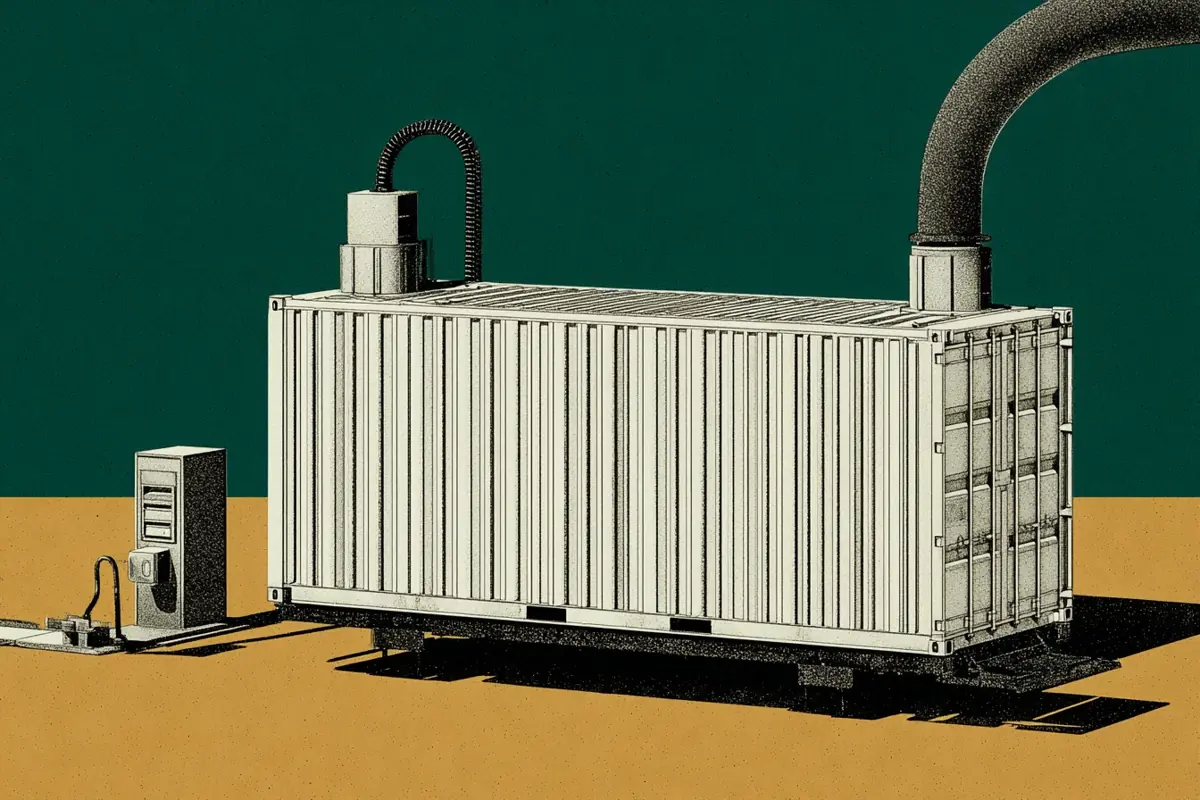
Distributed BESS in PJM: Skip the queue and access wholesale revenues with a WMPA
How the distribution route reaches the full wholesale revenue stack in months, not years. Read more →
The distribution grid offers a way around that wait. A battery of 20 MW or less, connecting below 69 kV, can interconnect in months rather than years through a Wholesale Market Participation Agreement (WMPA), and still reach the full wholesale revenue stack (Modo Energy, 2026). PJM has also opened new transmission-side tracks: an Expedited Interconnection Track for shovel-ready state-sponsored projects, approved in June 2026 and sunsetting at the end of 2027, and surplus-interconnection reform that lets storage reuse existing points of connection (PJM, 2026).
Those reforms sit behind a much larger pipeline. Transition Cycle 2 studies roughly 50 GW of nameplate capacity, including the Reliability Resource Initiative, and PJM's transition-period projects are expected to add 9 to 13 GW of BESS by 2032, concentrated in the Dominion and AEP zones (PJM, 2026). Choosing the WMPA or expedited route over the standard cycle can pull a project's first revenue forward by more than a year.
7. How do state mandates support PJM battery revenue?
Four PJM states now back storage with binding targets and competitive procurements in three of them (Maryland, New Jersey, and Illinois), which can offer contracted revenue to de-risk merchant exposure. Virginia instead sets a target Dominion must find its own way to meet. Multiple award decisions land through 2026, so the mandates are an active pipeline rather than a distant promise.
Virginia's 2026 legislation directs roughly 21 GW of storage by 2045, led by Dominion; Maryland targets 3 GW by 2033; New Jersey targets 2 GW by 2030; and Illinois targets 3 GW by 2030 under its Clean and Reliable Grid Affordability Act (Modo Energy, 2026).

The four states supporting BESS in PJM
The targets, mechanisms, and 2026 award dates state by state. Read more →
New Jersey awarded 355 MW across three transmission-connected projects in March 2026 and has a 645 MW second tranche with bids due in August (Modo Energy, 2026). Illinois runs a first procurement of 1,038 MW, of which 588 MW sits in PJM, under a 20-year indexed storage credit. Maryland received about 1,375 MW of applications against an 800 MW first-round target, with a decision due by October 2026.
For owners and lenders, these programs turn a merchant business into a partly contracted one. A fixed-payment award or an indexed storage credit provides a revenue floor that supports debt, in a market where the merchant stack is volatile.
8. Can you finance a PJM battery in 2026?
The federal tax credits for standalone storage survived 2026 reform, and financing is available. PJM still lags the other large US markets on disclosed deal flow, but that reflects an emerging-scale fleet and thin contracted offtake, not a weak revenue case, and state procurement is now filling the gap.
The One Big Beautiful Bill Act preserved the full investment tax credit for standalone storage through 2033, phasing down from 2034, and kept credit transferability, a longer horizon than solar or wind now have (IRS, 2026). The binding constraint is the foreign-entity rule: to claim the credit, a project's material-assistance cost ratio (the share of its components that must come from approved non-Chinese sources) must reach at least 55% in 2026, rising five percentage points a year to 75% by 2030, which pushes cell and component sourcing away from China (IRS, 2026).
Projects that began construction before 2026 are exempt from the test, and IRS safe-harbor cost tables give developers a method to demonstrate compliance.

U.S. BESS Capital Markets Report - Q2 2026
Modo Energy's quarterly U.S. BESS capital markets report, tracking deal flow, lenders, and structures by market. Read more →
The wider US market is growing, even though PJM's disclosed deal flow has stayed thin. Modo Energy tracked 12 US BESS deals in the second quarter of 2026, adding 3.8 GW of battery capacity with $14.3 billion of disclosed debt, more than five times the prior quarter (Modo Energy, 2026). Disclosed deal count fell from 18, but the average deal roughly tripled in size as three multi-billion-dollar solar-plus-storage projects closed. No deals were disclosed in PJM, SPP, or ISO-NE. US banks returned after three quarters away. Wells Fargo, J.P. Morgan, Truist, KeyBanc, and CoBank all joined second-quarter syndicates, though NordLB led overall, appearing in five of the quarter's seven financings.
The financings that closed in the second quarter of 2026 leaned on contracted offtake, from Enlight's CO Bar on five 20-year power-purchase agreements to Plus Power's Crawfish Creek on a 20-year Tennessee Valley Authority deal (Modo Energy, 2026). In PJM, that offtake anchor is only now arriving through state procurement.
PJM's thin disclosed deal flow comes down to market structure and fleet scale. The deals that closed leaned on contracted revenue, such as tolling agreements and resource-adequacy deals, where a counterparty pays a fixed fee to keep a battery's capacity available. PJM has historically seen few such contracts. The quarter's largest financings were solar-plus-storage hybrids in the West and Midwest, each backed by long-term utility power-purchase agreements of a kind PJM's merchant-heavy market rarely offers. PJM's operating fleet is also still under 600 MW, against more than 15 GW each in ERCOT and CAISO (Modo Energy, 2026).
But this gap will start to close. State procurement in Virginia, Maryland, New Jersey, and Illinois is adding the contracted offtake that made these deals bankable, the capacity auction has set a high revenue floor, and interconnection reform is moving projects toward commercial readiness. Modo Energy frames the open question as whether PJM converts its elevated capacity prices into closed financings in the second half of 2026, not whether the revenue is there (Modo Energy, 2026). For lenders, PJM is the market to diligence now, before the first wave prices in.



Frequently asked questions
What is PJM?
PJM Interconnection is the largest power market in the United States, coordinating the grid for 67 million people across 13 states and Washington DC. Its summer peak demand runs around 150 to 160 GW, and it operates the wholesale energy, capacity, and ancillary-service markets in which batteries earn revenue.
How do batteries make money in PJM?
PJM batteries stack three revenue streams: regulation, energy arbitrage, and capacity. Since the October 2025 Regulation redesign, regulation has been the largest, supplying most of a typical fleet's revenue (Modo Energy, 2026). Energy arbitrage and capacity payments provide the rest.
Why are PJM capacity prices so high?
PJM's capacity auction has cleared at its regulated cap for three straight auctions, most recently at $325/MW-day for 2028/29, because supply is falling short of a reliability requirement driven up by data-centre load (Modo Energy, 2026). The 2028/29 auction cleared 6.8 GW short of target.
What did the October 2025 Regulation redesign change?
It merged PJM's legacy RegA and RegD signals into a single, precision-scored regulation product, roughly doubling the addressable market for batteries and lifting clearing prices (Modo Energy, 2025). Fleet revenue roughly tripled, from about $20 to $62/kW-month.
Where are the best PJM zones for batteries?
The Mid-Atlantic leads. In June 2026, real-time four-hour spreads reached $1,026/MW-day in Baltimore, $939 in Washington DC, and $859 in Virginia, far above western zones (Modo Energy, 2026). Transmission constraints keep the east premium in place through Modo Energy's long-run forecast.
How long does PJM interconnection take?
The standard transition cycle runs close to two years. A distributed battery of 20 MW or less, connecting below 69 kV through a Wholesale Market Participation Agreement, can interconnect in months and still reach the full wholesale revenue stack (Modo Energy, 2026).
Do federal tax credits still support PJM storage in 2026?
Yes. Standalone storage keeps the full investment tax credit through 2033, phasing down from 2034, and transferability survived (IRS, 2026). The binding constraint is the foreign-entity sourcing rule, which requires a material-assistance cost ratio of at least 55% in 2026, rising to 75% by 2030.
What tool can I use to get live and forecast data on PJM BESS revenues?
Ko is Modo Energy's AI assistant, built on proprietary revenue data and forecasts for grid-scale BESS and solar across all seven US ISOs and RTOs, Great Britain, Germany, Spain/Iberia, Italy, France, and Australia. It covers wholesale price forecasts, market design, regulation, and policy out to 2050. It is a practical tool for revenue modelling, project development, and regulatory analysis.
Modo Energy is the independent benchmark for battery energy storage revenues and buildout across the US, Great Britain, Europe, and Australia. For live PJM data and long-range forecasts, explore the Modo Terminal.
About the author
Neil Weaver is a Power Market Analyst at Modo Energy. Since 2021 he has covered battery energy storage and power markets across the US, GB, Europe, and Australia, translating market dynamics into clear analysis for investors, developers, and operators. He is the writer and presenter of The Energy Academy: Great Britain (watch on YouTube). Find Neil on LinkedIn.
Related articles