How co-location affects hybrid battery revenues in the NEM
The amount of hybrid battery projects pairing storage with wind and solar is set to massively expand in the NEM. There are 5 GW of co-located projects in the NEM aiming to enter operation before the end of 2028, compared to only 0.6 GW today. Of those projects, 3 GW are hybrid projects where the BESS and wind or solar generation share a grid connection.
Hybrid batteries offer many benefits over standalone. These include maximising usage of the existing grid connection, reducing technical curtailment, and improving site MLFs. However, hybrid batteries risk export constraints from sharing a limited grid connection with renewable generation. This restricts optimisation and can reduce the revenues that a hybrid battery can capture from energy trading.
In this report, we analyse the impacts of export limits on revenues for batteries of different sizes. This report also analyses how the effects of export limits on revenues would change in the future.
Executive summary
- Developers can upsize solar-coupled hybrid batteries with minimal risk of export limits lowering battery revenues. Export limits have an immaterial effect on revenues for solar-coupled hybrid BESS. This is because high prices almost never occur when solar generation is high enough to limit battery exports.
- There is greater risk of export limits lowering revenues for wind-coupled hybrid BESS. This is especially true when battery power increases relative to the wind capacity (and grid connection limit). However, we only expect it to reduce BESS revenues by less than 5% over the lifetime of the asset.
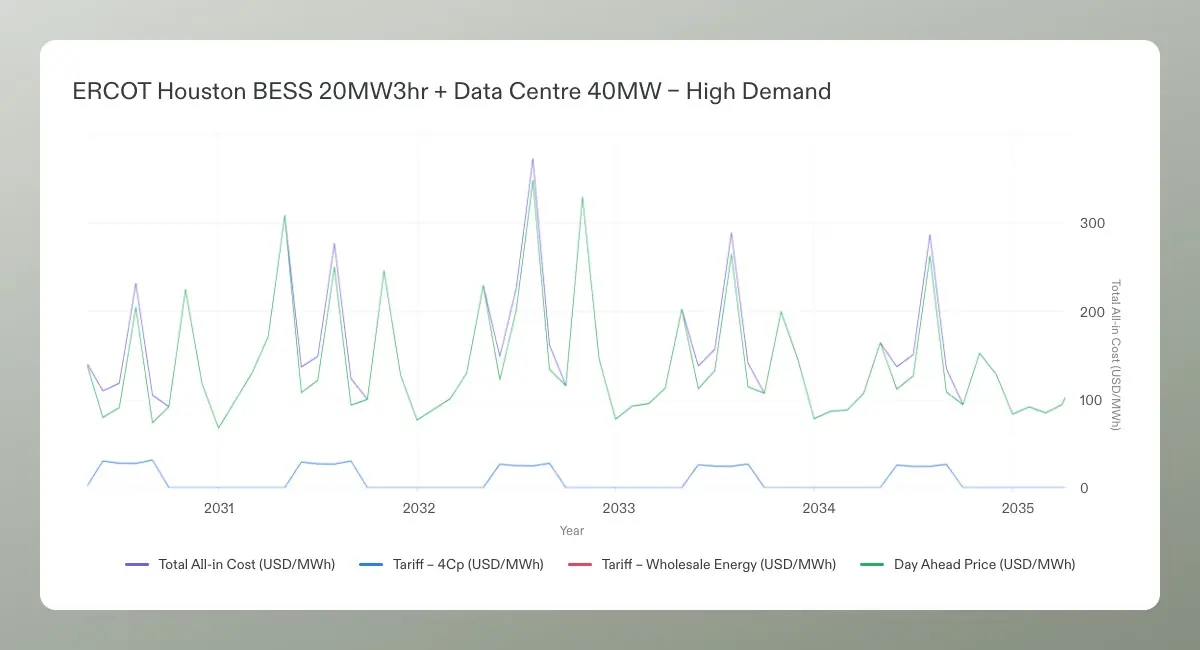
- Revenue loss from export limits for existing batteries are minimal, and the Modo Energy Forecast indicates that revenue reduction from export limits will remain minimal in the future. However, some years have much larger revenue reduction for wind-coupled BESS due to extreme prices coinciding with high wind generation, limiting battery exports.
Co-location in a hybrid facility minimally impacts energy trading revenues for batteries
Co-locating a BESS with a wind or solar facility lowers battery export headroom averaged across the day. But this minimally impacts energy trading revenues for the battery.
Sign up to read this article for free
Unlimited access to our free articles
Monthly access to 2 Global Research articles
Benchmarks, Forecasts, Ko and more