Australia NEM BESS Forecast: February 2026 release
The February 2026 version of Modo Energy’s battery energy storage revenue forecast for Australia’s NEM is now live. Most significantly, near-term battery capacity increases and coal retirement dates are delayed. This release also introduces refined bidding tiers, updated capacity expansion, and updated commodity prices and degradation assumptions.
Modo Energy forecast subscribers - create your own asset specific forecast now with the latest update.
Key updates:
- Near-term battery capacity up ~1.7 GW by end of 2029 compared to the November 2025 outlook, reflecting committed projects and latest CIS and LTESA tender results.
- Eraring retirement extended to 2029 for all four units (2,880 MW), and Callide B retirement delayed to end of 2031.
- Commodity prices reduce reflecting latest market movements, most significantly an up to 11% fall in gas prices through to 2029.
- PPA bidding tiers now differentiate no-floor, floored, and zero-price/merchant contracts, driving more negative pricing.
- Updated battery degradation profile reflecting real-world curves.
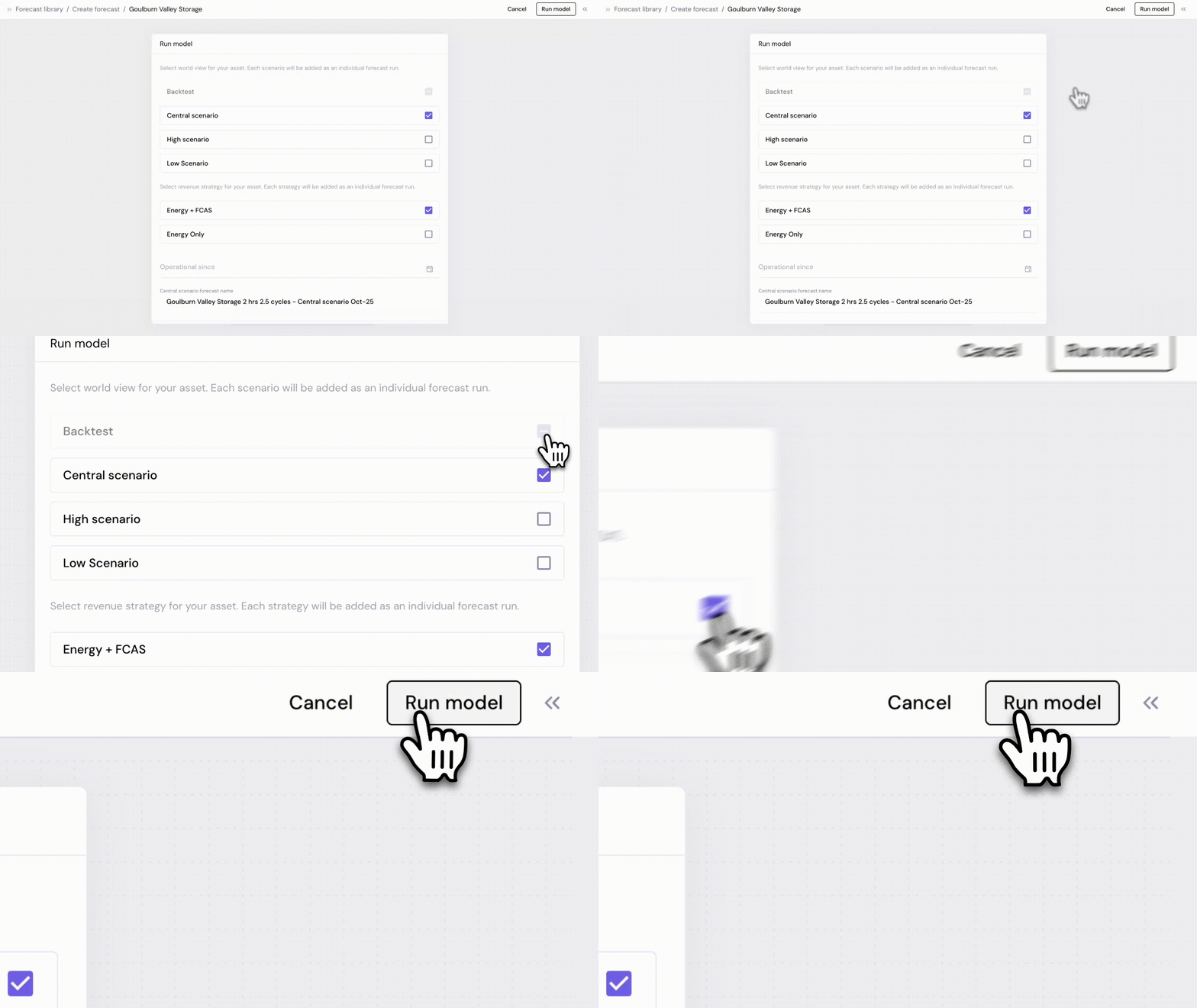
New feature: Backtest revenues
Run our battery dispatch model for your specific asset configuration against historical NEM prices to see how your asset would have performed. Validate historic performance and create a bespoke benchmark based on what could have been earned.
Modelling changes
Updated bid tiers drive increased negative pricing
We’ve refined how renewables bid into the market, reflecting continued increases in the number of zero or negative prices.
The model splits renewable capacity across three bidding tiers reflecting the diversity in negative bid prices across renewable operators. Additionally, wind capacity forecasts for unit commitment decisions are more conservative, based on real-world management of under-supply risk.
Following a surge in Q4, instances of negative prices are projected to stabilise in most states as new energy storage capacity comes online - both grid-scale and domestic.
Capacity expansion shifts towards more storage long term
Our economic capacity expansion optimises capacity build across all technology types and battery durations simultaneously and captures the synergies between new renewables and storage. The methodology underpinning this has been enhanced this release. This results in a capacity trajectory with less renewables and more dispatchable capacity, especially battery energy storage, compared to the ISP.
Key input changes
Near-term battery pipeline strengthens by ~1.9 GW
Grid-scale battery capacity projections have increased following project commitments in Q4 and the inclusion of the latest LTESA and CIS projects. We now expect approximately 1.9 GW of additional BESS capacity online by the start of 2030 compared to our November 2025 outlook, bringing the total BESS capacity to a projected 19.6 GW.
This increase has the impact of compressing spreads further in the short term before the retirement of Eraring in 2029.
Updated battery degradation profile reflects real-world curves
Battery degradation profiles have been refreshed to better reflect the degradation our customers actually see in practice - which is driven not just by physical cell aging, but also by oversizing strategies and other factors under the manufacturer’s control. This results in a shallower degradation profile than the default in the previous release.
Coal retirement delays reshape the near-term supply stack
Three coal retirement timeline changes are captured in this release, resulting in an increase of 1.4 GW of operational capacity in the next two years and 0.7 GW through to 2032.
- Eraring Power Station (New South Wales, 2,880 MW Coal) - all four units now expected to operate until April 2029, reflecting Origin Energy's announced deferral. As the NEM's largest coal plant, this extension materially affects baseload supply through to 2029.
- Callide B (Queensland, 700 MW Coal) - retirement extended to end of 2031, from 2028 previously. This follows the Queensland government’s announcement of the extension in its Queensland Energy Roadmap.
- Yallourn West (Victoria, 1450 MW Brown Coal) - retirement extended 2 months to September 2028. This reflects the industry norm of avoiding winter closure dates.
Together, these extensions keep over 3.5 GW of coal capacity in the system longer than previously assumed, moderating near terms spreads.
Reduced commodity prices reflect recent market movements
We’ve refreshed our commodity prices based on latest market trends. Most significantly, a decline in gas futures leads to compressed spreads in the near term. LGC prices continue to decline, continuing an ongoing trend.