SPP Market Outlook October 2026: Five scenarios
Modo Energy’s October 2026 SPP forecast is now live.
This release introduces four new scenarios alongside an updated Central case to capture key investment risks related to the future of SPP's demand and generation mix.
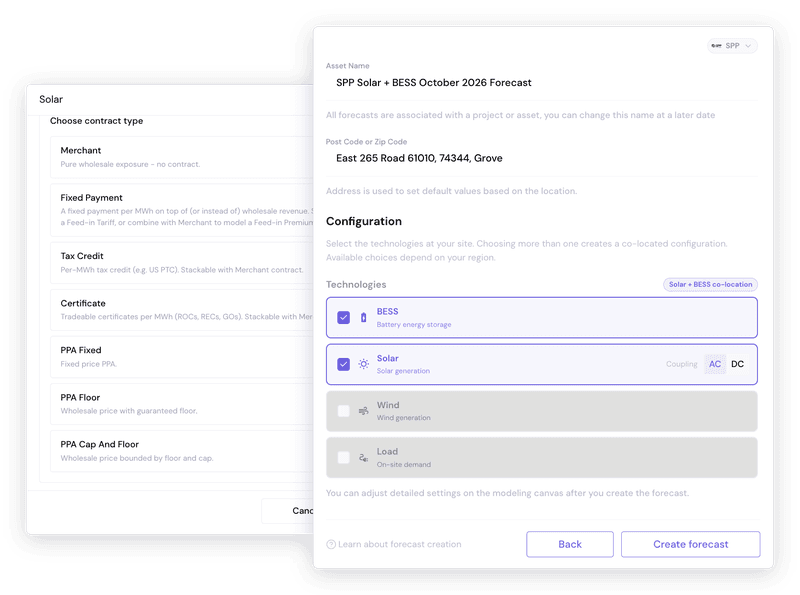
The new release also adds two new asset configurations to the forecast: standalone solar and co-located solar plus storage. Forecast users can model revenue contracts alongside these new assets to evaluate offtake decisions.
Executive Summary
SPP will retire most of its aging coal fleet in the next two decades, falling from 21 GW today to 6 GW by 2050.
This loss in thermal capacity comes alongside accelerating large load interconnection. Disclosed figures from SPP put current large load interconnection requests at 20 GW by 2045, led by oil and gas electrification in the Permian Basin and rapid data center growth.
And if programs like HILLGA facilitate spot loads - as modeled in our new High Demand scenario - growth could accelerate to SPP's Future 2 trajectory, reaching 33 GW grid-connected capacity by 2045.
This is against a peak load of 58 GW today.
To keep pace with resource adequacy needs, SPP is fast-tracking firm capacity. The ERAS queue places 15 GW of utility-contracted gas on track for 2030.
As gas replaces the retiring coal fleet, nameplate installed capacity of gas-fired generation is projected to double to 79 GW by 2050.
Their increasing prevalence in setting peak prices relative to wind makes gas futures a key risk impacting asset returns. The High Gas Prices and Low Gas Prices scenarios bound this impact to ±$6/MWh on baseload power prices.
Against this backdrop, a new renewable asset class rapidly joins SPP's dominant wind fleet: solar and storage.
Solar capture prices hover around $40/MWh today, with a capture rate over 130%.
But if global R&D leads to deeper CapEx reductions, and this causes solar build-out to accelerate, capture rates could halve by 2045.
Modeling changes
Regulation and Reserve awards are modeled with an acceptance rate
The Central scenario projects nearly 14 GW of batteries by 2032. Batteries will offer far more capacity than SPP’s Ancillary Services require, so not every offer can clear.
The October release reflects this with an acceptance rate: the likelihood that a battery's offer to provide Ancillary Service capacity clears.
Sign up to read this article for free
Unlimited access to our free articles
Monthly access to 2 Global Research articles
Benchmarks, Forecasts, Ko and more