Inside Summer Sessions '26
Last Thursday, more than 800 people from across the battery and renewables industry gathered at Protein Studios in Shoreditch for Modo Energy's first Summer Sessions. Nearly twice that number applied to attend.
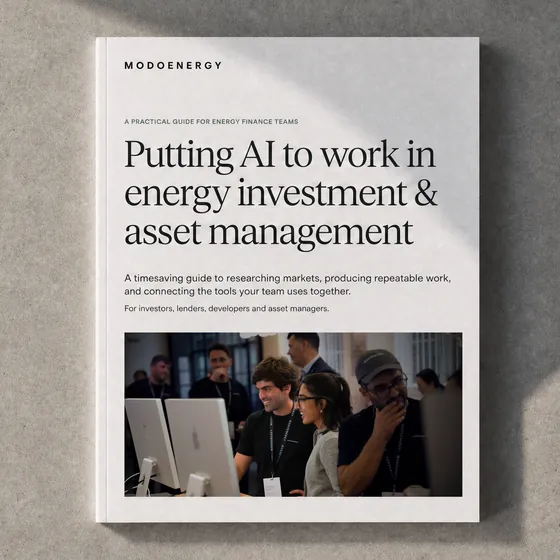 Free guide from Modo EnergyPutting AI to work in energy investment and asset managementTurning market analysis like this into a repeatable process? A practical playbook for using AI tools across your energy investment and operations teams, featuring tangible, timesaving tips and tricks you can put to use immediately.Download the guide →
Across the afternoon, nine speakers gave their honest read on where the market is heading. Click a name for their slides, or a talk title for the full video:
- Michael Liebreich (Liebreich Associates) — the global transition, in fast-forward
- Robyn Lucas (Modo Energy) — GB's battery paradox: decoupling gas, compressing revenues
- Stuart Jackson (Octopus Energy) & Quentin Scrimshire (Modo Energy) — a fireside chat on building at scale
- Till Stehr (Modo Energy) — from gridlock to gigawatts: is the German storage boom coming?
- Amit Gudka (Field) — lessons from building a vertically integrated storage company
- Rimshah Javed (Danske Commodities) — tolling, from an offtaker's perspective
- Dr. Kai-Philipp Kairies (ACCURE) — turning state-of-charge accuracy into 5% more revenue
- Ed Porter (Modo Energy) — the future of power markets
- Quentin Scrimshire (Modo Energy) — the end of the consultancy era
The afternoon ran as a single track — eight talks and a fireside chat, then an evening with much of the European storage market in one room. A Ko Bar let attendees put Modo Energy's AI analyst to work on their own questions. Each speaker was asked the same thing: where is the market actually going?
This is what they said.

1. A transition in fast-forward
The world is in its second fossil-fuel shock in four years, and for the first time it has reached for new technologies rather than old ones. Keynote speaker Michael Liebreich, founder of New Energy Finance and an early Modo Energy investor, called it the Great Clean Energy Acceleration, with a second wave now underway.

The evidence is in the build rate. Roughly 90% of what gets added to the world's grids is now wind and solar, with each generating more electricity than nuclear. Batteries, he argued, are at the inflection point wind and solar hit around 2015. He points out, however, that China leads the entire clean-energy stack. And despite requests for 400 GW of AI data centers in Texas, Liebreich does not find it likely that most will be built.
"China's domination is not just of solar and batteries, and not just of critical minerals, but right up and down the clean energy stack."
- Michael Liebreich, Liebreich Associates
2. Great Britain: gas decouples
For the first time, GB power prices are decoupling from gas. In 2026, wind and solar will set the average price for 20% of days - at a lower level. But that comes at a cost to battery storage, and it's the paradox at the heart of the GB market. Robyn Lucas, head of Modo Energy’s GB team, walks us through it:

Batteries are self-cannibalising. The more of them on the system, the softer power price spreads become. Britain had 1.3 GW of BESS in February 2022, today in 2026 there is over 7 GW. This fleet of battery storage has displaced expensive peaking gas and saved consumers £188 million since December 2024. The average two-hour battery earned around £68,000/MW/year on Modo Energy's 2h index over the last 18 months. These revenues are volatile, which is why the market maturing from building floors, to contracting tolls and swaps.
Find Robyn’s slides here.
"We are decoupling power prices from gas - and on those days it's wind and solar setting the price. And it's cheaper."
- Robyn Lucas, Modo Energy
3. The energy transition's first 80% is the easy part
Ed Porter, Modo Energy's Director of EMEA & APAC, took the global view. Cheap solar (Spanish prices now hit €0/MWh for six or seven hours a day) and batteries that supply upward flexibility more cheaply than gas mean the market can already finish off roughly 80% of the job and push a lot of gas off the system.

The harder question is the brutal 20%: the Dunkelflaute, the windless, sunless fortnight that arrives once every five years. Batteries meet the gigawatt peak, but they can't close an energy gap of 10 to 15 terawatt-hours. Porter's point was that the last 20% may not be worth chasing. It's expensive, and the power system might do more good by helping every other sector electrify faster.
Find Ed’s slides here.
"Is it our job to chase the last few tonnes out of power emissions, or to let the power system help every other sector move faster?"
- Ed Porter, Modo Energy
4. Germany: the right ingredients, the missing batteries
Germany should be booming. It isn't. It has 120 GW of solar, five times Britain's, and a system so short of flexibility that on 1 May the day-ahead price nearly failed to clear at -€500/MWh, then spiked to €846/MWh that evening. Yet it has just 3 GW of grid-scale storage, roughly where Britain was seven years ago.

Till Stehr's diagnosis: uncertainty. Years of regulatory debate, restrictive grid-connection terms, and a decade spent regulating for a hydrogen economy no one is using yet. But, the outlook is improving. Dynamic grid fees would pay batteries to charge in solar-flooded regions, and Modo Energy's modelling points to a 14% IRR for an asset commissioned in 2030, including the latest policy changes.
Find Till’s slides here.
"We need to go from three gigawatts to 60. All that remains is to build 57 GW of batteries."
- Till Stehr, Modo Energy
5. Build or buy: how much of the value chain should you own?
Two operators gave opposite answers to the same question. Stuart Jackson, CFO and co-founder of Octopus Energy (a business in around 25 countries, with 12 million customers and an $8 billion investment portfolio), argued against owning generation. Stability can be bought synthetically and contractually, so the capital isn't worth tying up.
"It's not yet clear to me that you have to own it. You can do practically everything that's needed synthetically and contractually."
- Stuart Jackson, Octopus Energy

Amit Gudka, CEO and founder of Field, took the other path. Field is vertically integrated: it develops, builds, operates and optimises in-house across four markets, to capture the feedback loops between each layer. His lesson was conviction over consensus. By the time a market is obvious, you're already too late.

"If you wait for a market to be obvious to develop in, you're often too late. You have to develop a bit uncomfortably early."
- Amit Gudka, Field
Own it or contract it, build it or buy it: two credible and opposite strategies for the same market, and a reminder that there's no settled answer yet.
6. The risks that don’t get priced in
Rimshah Javed, a senior originator at Danske Commodities, gave an offtaker's view of tolling. The deals that fail tend to fail on risk that was never priced in at the outset, and the fix is structuring incentives rather than blunt penalties, across a contract that can run 10 or 15 years.
"A toll takes a year to negotiate, and it can take a day for it to go wrong."
- Rimshah Javed, Danske Commodities

Dr. Kai-Philipp Kairies, CEO of ACCURE Battery Intelligence, went inside the box. Most of the day treated a battery as a container for electrons. He asked what's actually happening on the DC side, and the answer was uncomfortable for a lot of people in the room: batteries routinely misjudge their own state of charge, by around 10% on LFP cells, and that uncertainty quietly erodes revenue.
"Getting 5% more from the same asset means you overpaid by 5% on CapEx - and a procurement team could get fired for that."
- Dr. Kai-Philipp Kairies, ACCURE Battery Intelligence

7. The end of the consultancy era
Quentin Scrimshire closed with the argument the day had built toward. For two decades the industry has run on consultancies — black-box models, PDFs, long cycles, high fees. Modo Energy automated and standardised that work, but that improved the model rather than replacing it. The model itself, he said, is now finished. He called the next chapter the era of agentic energy analytics.

Analysts spend perhaps 80% of their time pulling numbers and rebuilding board packs, and 20% on the judgment that moves a decision. Ko is built to invert that, to take a task, plan it, run the forecast, check its own work, and hand back something the analyst can interrogate. Three months after launch, a quarter of Modo Energy's 30,000 Terminal users are weekly active on Ko and a fifth use it daily. Internally, analysts now spend more than half their time training it. To close, Scrimshire removed every usage limit on Ko for all paying customers for a month.
Download Quentin’s slides here.
"The consultancy era is over. It's over for us, but we also think it's over for the market - because technology now lets us do far more for our customers."
- Quentin Scrimshire, Modo Energy
What the day signalled
The clearest signal was who was in the room: developers, optimisers, traders, investors, banks, utilities and counterparties, much of the market that finances and operates European storage, together for an afternoon.

That's the thread running through the talks and through Ko itself. As the market matures, the advantage shifts from who can gather the data to who can act on it fastest. Nearly twice as many people wanted a seat as the room could hold, which is reason enough to expect a second Summer Sessions.