Italy's balancing services: how batteries participate and get paid
Italy's balancing services: how batteries participate and get paid
Beyond wholesale trading, Italian BESS assets are active in balancing services.
 Free guide from Modo EnergyPutting AI to work in energy investment and asset managementKeeping up with fast-moving Italy ancillary markets? A practical playbook for using AI tools across your energy investment and operations teams, featuring tangible, timesaving tips and tricks you can put to use immediately.Download the guide →
Terna, Italy's transmission system operator, procures energy to keep grid frequency stable and avoid congestion.
This article explains how these balancing revenues work, from Italy's wholesale markets to Terna's dispatching platform.
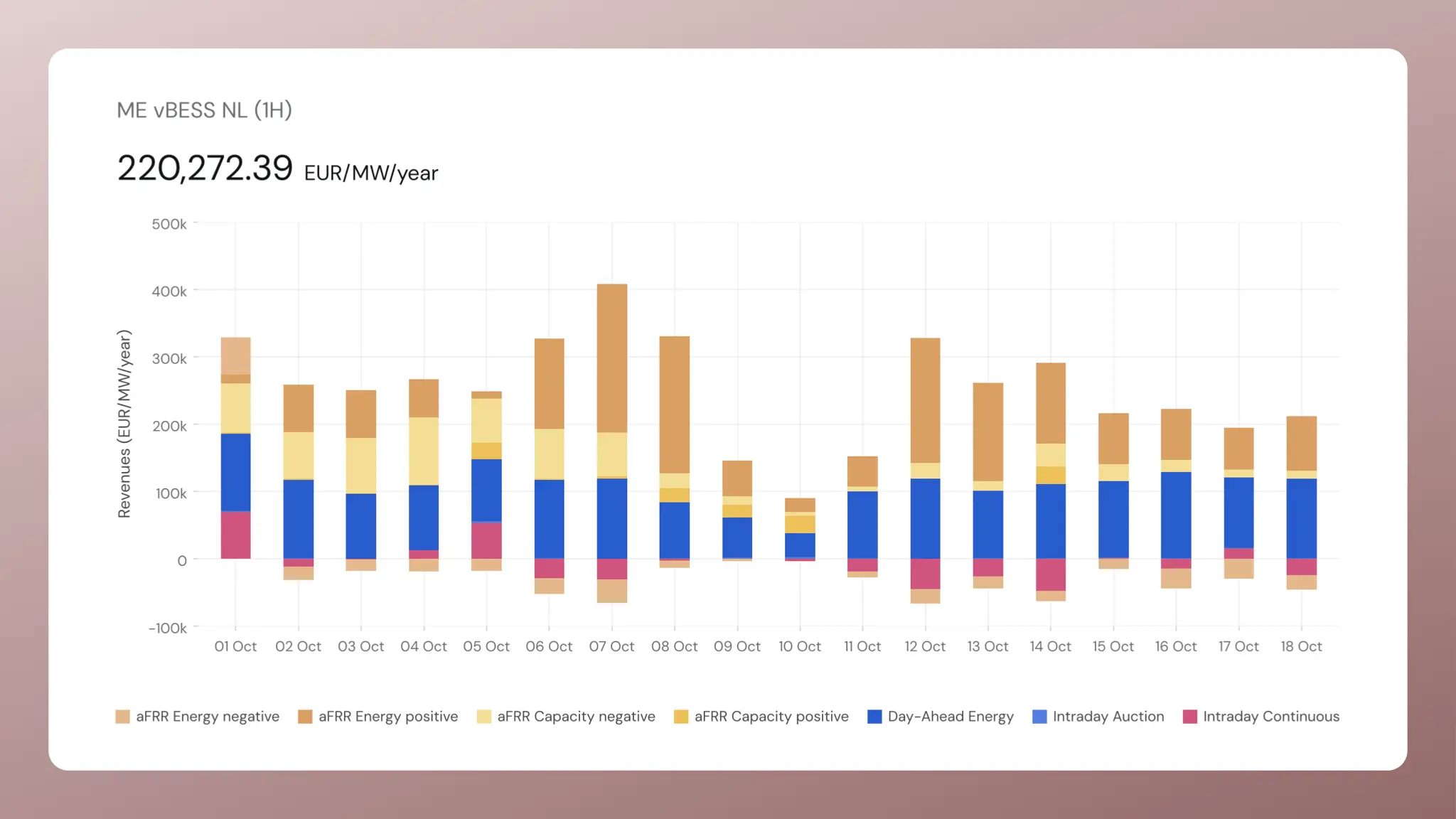
Live figures for Italian battery revenues are available on the Modo Energy vBESS Index.
Wholesale sets the trade, Terna adjusts it toward physical delivery
Gestore dei Mercati Energetici (GME), Italy's power exchange, runs the day-ahead market, Mercato del Giorno Prima (MGP).
It also runs intraday trading through auctions (MI-A) and continuous trading (MI-XBID).
These markets set and revise a BESS asset's trading position.
Terna then selects adjustments through the national dispatching market, Mercato per il Servizio di Dispacciamento (MSD) divided in 3 main products.
- MSD ex-ante stage prepares schedules and reserves.
- Mercato di Bilanciamento (MB) provides manual adjustments.
- Automatic frequency restoration reserve (aFRR) follows a control signal;
Terna increasingly selects resources closer to real-time delivery.
This has cut MSD ex-ante volumes and raised the importance of real-time balancing.
Sign up to read this article for free
Unlimited access to our free articles
Monthly access to 2 Global Research articles
Benchmarks, Forecasts, Ko and more