ERCOT's generation firming requirement: a non-event early, a structural cost for wind & solar later
ERCOT's generation firming requirement: a non-event early, a structural cost for wind & solar later
House Bill 1500, passed by the 88th Texas Legislature in 2023, stipulated that new generators in ERCOT would be required to 'firm' their capacity, or simply be available at a certain percentage of their installed nameplate capacity, during hours of high reliability risk - or face a penalty.
The ERCOT Board approved the implementing rules, Nodal Protocol Revision Request (NPRR) 1328, on September 15, 2026. The program now goes to the Public Utility Commission of Texas. The bill requires it to be in place by December 1, 2027.
The penalty applies only in hours when ERCOT's operating reserves fall below 3,000 MW. That has not happened on any day since September 2023.
That is the near-term picture. With the trigger condition absent and no resources obligated until 2028, the program costs generators nothing today.
The longer-run picture is different. The obligation is sized on a whole-season average of a plant's output potential. In the hours when reserves are at their lowest, wind and solar produce far less than that average. Solar is close to zero after sunset and before dawn. Wind runs well below its seasonal mean in summer scarcity hours.
So if hours with reserves below 3,000 MW return, wind and solar are the resources most exposed to the penalty. Solar falls short in every season. Wind falls short in summer, and in extreme winter weather.
Key takeaways
- The firming requirement is unlikely to bind in the short term. Reserves have not fallen below 3,000 MW since September 2023. The low point since then was 4,213 MW in January 2026, and summer 2026 bottomed at 4,533 MW.
- A solar plant's summer obligation is about 27% of nameplate. In the post-sunset hours when reserves are lowest, solar output is typically about 2% of nameplate.
- Wind's summer obligation is about 32% of nameplate. In hours when reserves were genuinely scarce, wind generation averaged 9.7% of nameplate.
- The program's theoretical maximum penalty is $60 per kW-year, for a plant obligated at the 75% cap that delivers nothing in all 60 binding hours. In a high-shortfall year, an unhedged solar plant would pay about $6.40 per kW-year and a wind plant about $6.80.
How the firming program works
The program applies to Generation Resources with an interconnection agreement executed on or after January 1, 2027, starting one year after the unit's commissioning date. Energy Storage Resources and generation inside a Private Use Network that mostly serves on-site load are excluded.
Each obligated resource receives a Seasonal Average Generation Capability, or SAGC. ERCOT takes the unit's telemetered High Sustained Limit, the maximum output it reports it could deliver in each five-minute interval, averages it across every interval of the same season over the prior five years, and caps the result at 75% of nameplate. For a 100 MW solar plant with a summer average output potential of 27% of nameplate, the SAGC is 27 MW.
That averaging method differs from how ERCOT accredits the same resources elsewhere. The December 2025 Capacity, Demand and Reserves report credits solar at about 5% of nameplate and wind at 9 to 18% at the summer peak net load hour, using Effective Load Carrying Capability, which measures what a resource contributes in the hours of highest risk. A whole-season average sits well above those values: 27% for solar and about 32% for wind in summer.
The obligation binds during Low Operation Reserve Hours. These are hours inside a fixed Generation Firming Baseline Period, made up of a morning ramp window, a seasonal evening ramp window, and any hours ERCOT's NERC probabilistic assessment identifies as high risk. For summer the evening window is hours ending 18 to 21. An hour counts if Physical Responsive Capability drops below 3,000 MW for at least 15 consecutive minutes. At most 15 hours count per season, and there are four seasons a year.
For the example plant, a binding hour with 2 MW of output potential and no day-ahead award or transfer produces a 25 MW shortfall. At $1,000/MWh, the charge is $25,000 for that hour. If all 15 hours in the season bind, the seasonal charge is $375,000, or $3.75 per kW.
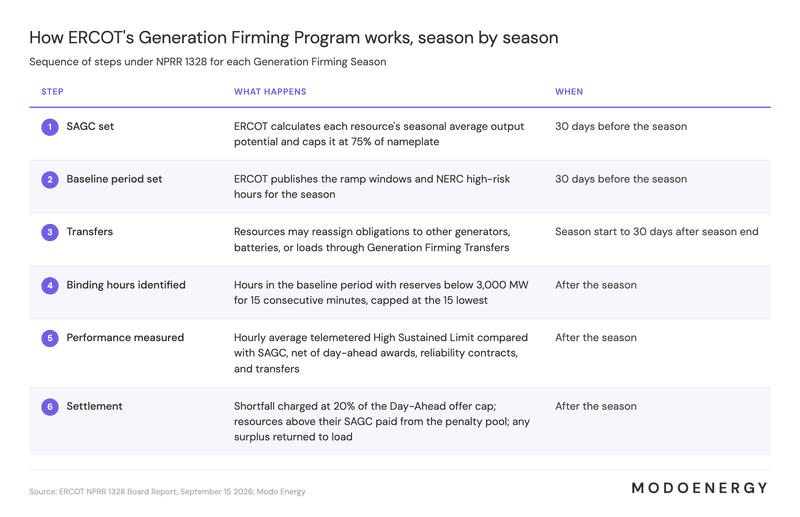
Day-ahead energy and ancillary service awards for the binding hour are netted off the requirement, as is capacity under a reliability contract. The obligation can also be reassigned through a bilateral Generation Firming Transfer. Planned outages, approved derates, and transmission outages are exempt for the hour. Forced outages and forced derates are not.
What a shortfall costs
The SAGC is a whole-season average, but the penalty applies only in the lowest-reserve hours. The gap between the two is the shortfall a plant carries into a binding hour.
Sign up to read this article for free
Unlimited access to our free articles
Monthly access to 2 Global Research articles
Benchmarks, Forecasts, Ko and more