WEM battery revenues returned to positive merchant territory in August 2026
WEM battery revenues returned to positive merchant territory in August 2026
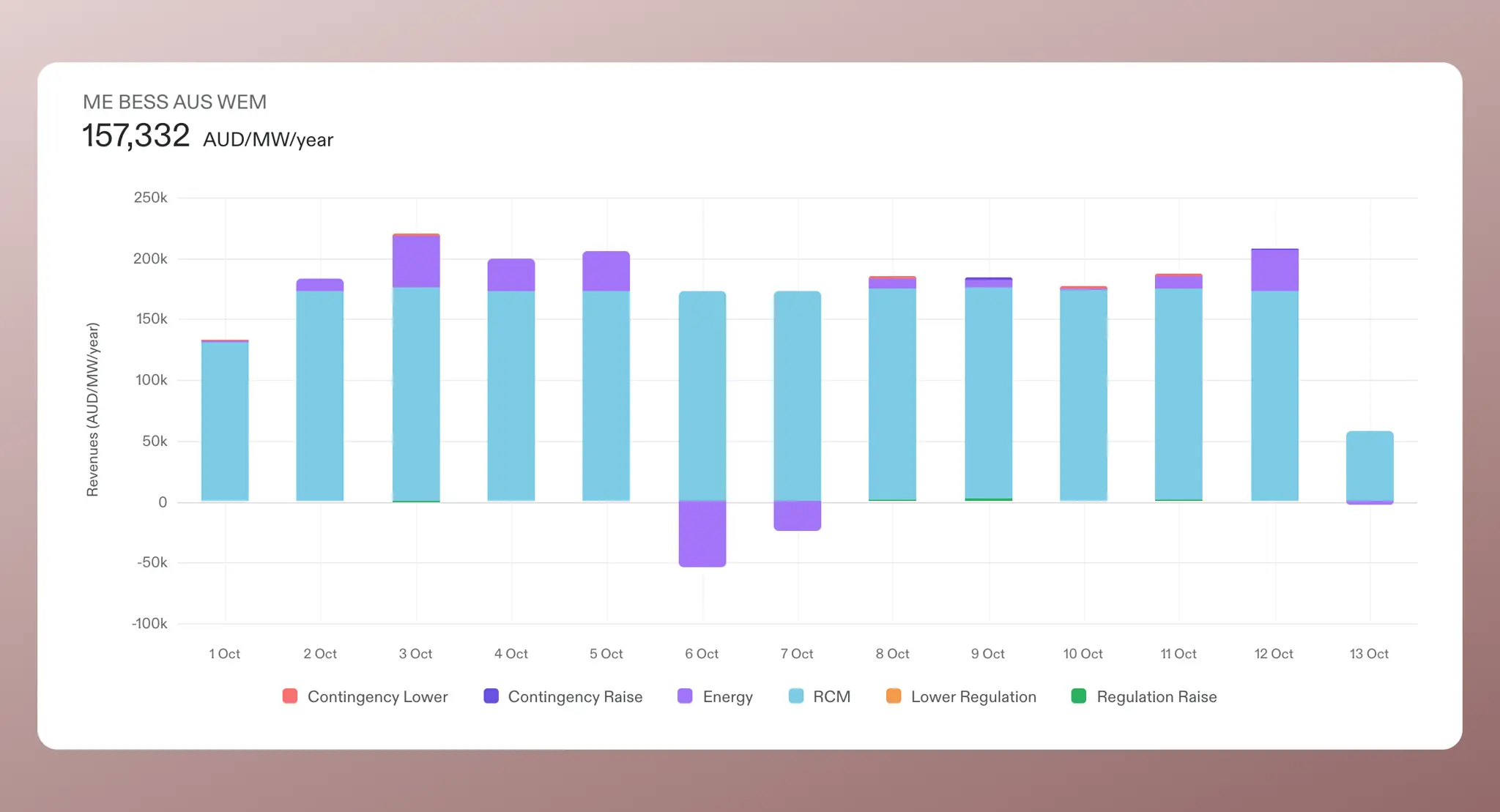
Energy prices and spreads eased in the Wholesale Electricity Market (WEM) in August, despite a rise in peak demand. Lower average prices reduced charging costs across the fleet, helping grid-scale battery revenues rise 24% month on month to $48k/MW/year. Merchant returns also moved back above zero for the first time since May.
Owner-level results remained split. Neoen’s two Collie batteries stayed merchant-positive, supported by wider realised spreads between charge and discharge prices. Synergy’s four batteries remained negative on a merchant basis, although losses narrowed as charging costs fell from July.
Fleet growth continues to weigh on returns. Grid-scale storage capacity has increased by more than half in the past year, increasing competition across the same daily arbitrage window. Capacity Credit and reliability contracts now account for most WEM battery revenues.
This article examines WEM battery revenues for August 2026, including merchant performance, realised charge and discharge prices, market conditions, price setting and fleet growth. Read July’s WEM battery revenue report here.
Executive summary
- WEM battery revenues rose 24% to $48k/MW/year in August. Merchant revenue returned to positive territory at $4k/MW/year, its first positive month since May.
- Lower average energy prices reduced charging costs. The 2-hour spread narrowed 10% to $114/MWh, but average energy prices fell 11% to $119/MWh.
- Synergy’s batteries remained negative on merchant revenue. The fleet recorded negative energy revenue on 74%, down from 81% in July.
- 17 August was Synergy’s largest single-day loss. Its four batteries charged together in three high-priced windows whilst Neoen discharged, costing Synergy -$294k.
Market conditions improved, but merchant upside stayed limited
Peak operational demand rose 8% to 3,629 MW in August, but average energy prices fell 11% to $119/MWh. Lower average prices reduced charging costs across the fleet, helping merchant revenue move back above zero for the first time since May.
Sign up to read this article for free
Unlimited access to our free articles
Monthly access to 2 Global Research articles
Benchmarks, Forecasts, Ko and more